
Is your anchor doing its job?
A framework for showing that an anchor measure sorts patients into meaningful change groups. With a one-page evidence record, a worked example and the slides from ISOQOL 2026.

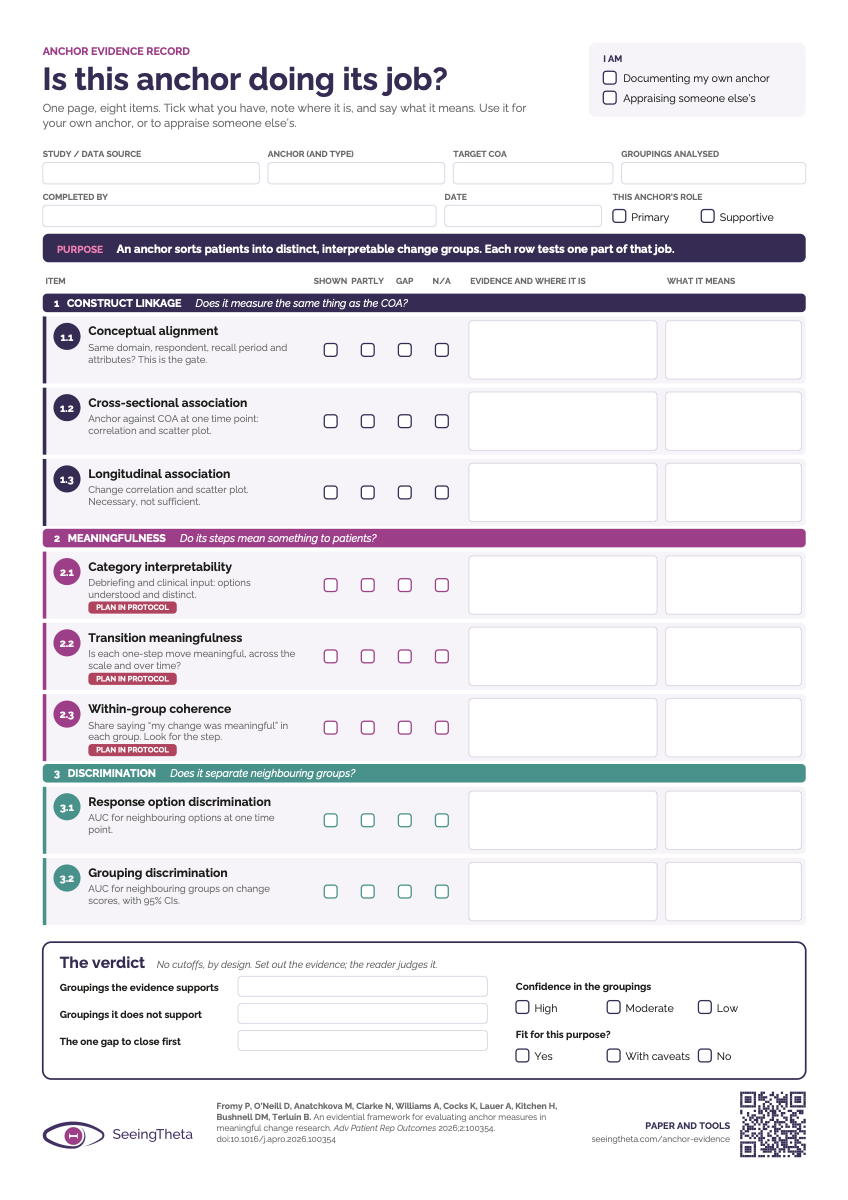
The framework
Anchor-based methods are the most common way to set meaningful change thresholds. Yet an anchor is often accepted on one number: its correlation with the COA.
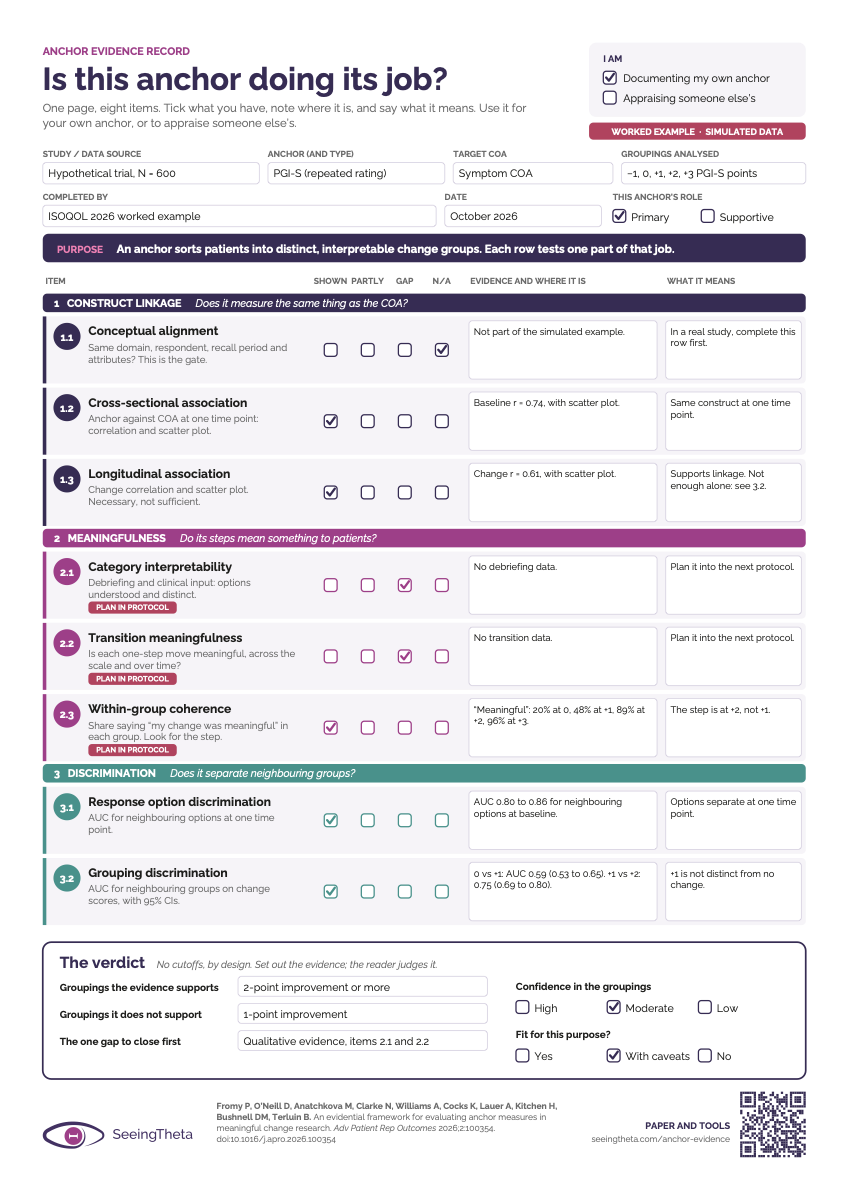
The framework starts from what an anchor is for. It sorts patients into change groups, so the evidence should show how well it does that. The evidence falls into three areas:
- Construct linkage. The anchor and the COA measure the same thing.
- Meaningfulness. Patients understand each response option, and each step between options is a change that matters to them.
- Discrimination. Neighbouring groups are distinct from each other.
There are no cut-offs. You set out the evidence, and the reader judges it.

How to cite
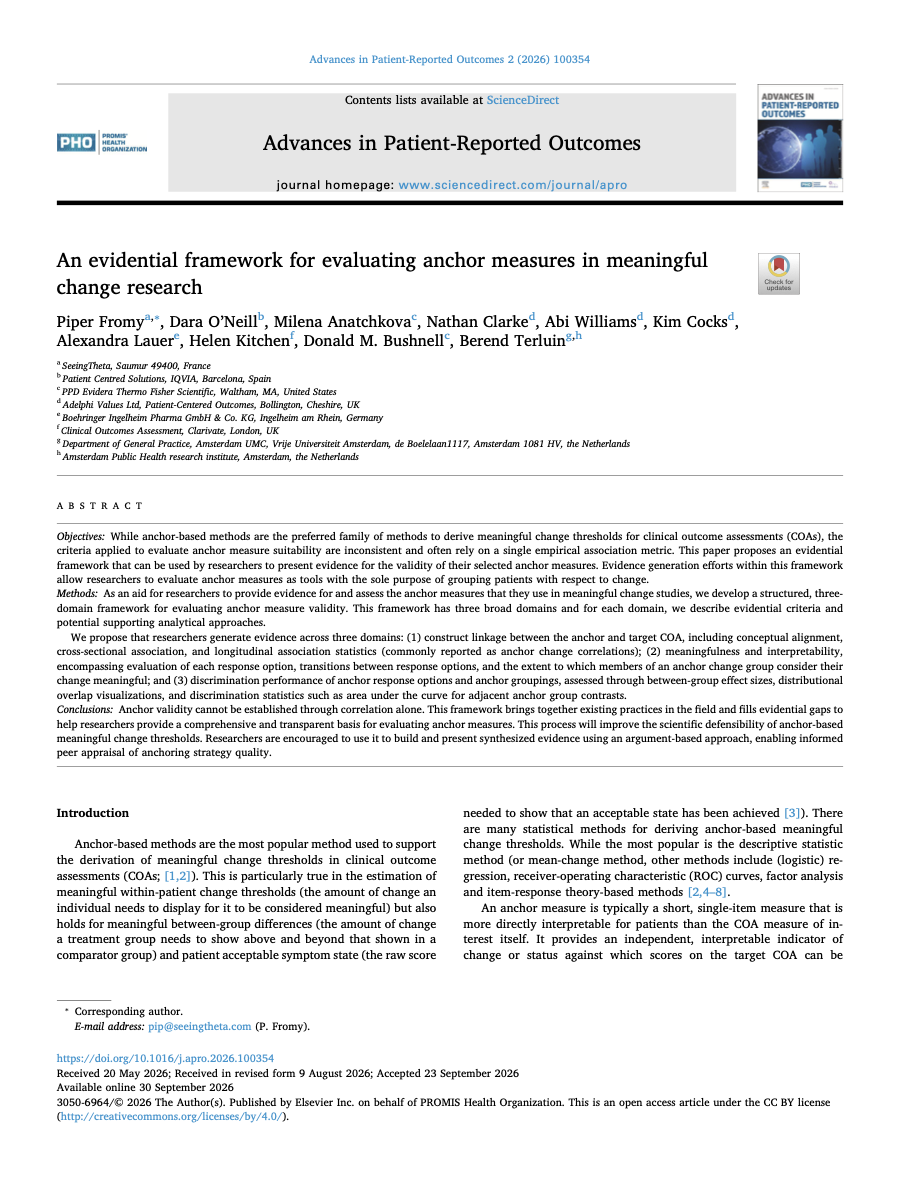
Fromy P, O'Neill D, Anatchkova M, Clarke N, Williams A, Cocks K, Lauer A, Kitchen H, Bushnell DM, Terluin B. An evidential framework for evaluating anchor measures in meaningful change research. Advances in Patient-Reported Outcomes. 2026;2(4):100354. doi:10.1016/j.apro.2026.100354